
Wan received a major upgrade on August 6, 2026, moving from Wan 2.7 to Wan 3.0. What’s new in Wan 3.0, how does it compare with Wan 2.7, and is it worth upgrading? Let’s take a closer look.
WAN 3.0 Release Date: Everything You Need to Know
Alibaba Cloud officially launched public beta access for Wan 3.0, its next-generation video generation model developed by Tongyi Lab.
- Release Date: Public beta opened on August 6, 2026.
- Access Model: Closed public beta and API via Alibaba's platforms (such as Model Studio and DashScope); it is not an open-source release with downloadable weights.
- API Pricing: Priced per second depending on resolution—¥0.3 for 480P, ¥0.6 for 720P, and ¥1.2 for 1080P (roughly $0.04 to $0.17 per second).
- Wan 3.0 supports four distinct generation methods: Text-to-Video, Image-to-Video, Multimodal Reference, and Document-to-Video.
WAN 3.0 Upgrade Explained: What’s New?
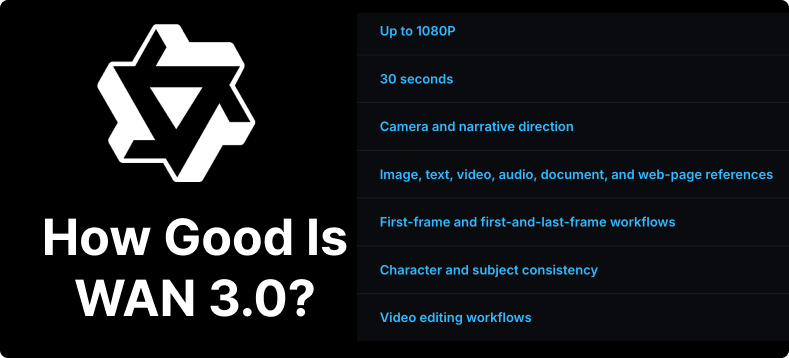
WAN 3.0 focuses on making AI video generation longer, more controllable, and more versatile. Compared with WAN 2.7, its key improvements include:
1. Up to 30-Second Video Generation
WAN 3.0 can generate around 30 seconds of continuous video in a single generation, compared with WAN 2.7's shorter native clips. This makes it more suitable for complete scenes, advertisements, storytelling, and longer social videos.
2. Document-to-Video Workflow
WAN 3.0 expands beyond traditional text, image, and video inputs. Its beta workflow reportedly supports documents, spreadsheets, presentations, PDFs, and other reference materials alongside text, images, audio, and video. This creates new possibilities for turning existing business or creative materials into video content.
3. Precision Timeline Inpainting
You can highlight a specific 3-second window within a 30-second clip to change a character's dialog, action, or background prop without altering the surrounding frames.
4. Better Text and Visual Consistency
WAN 3.0 puts greater emphasis on readable text, stable references, and visual consistency throughout a generated sequence. This is especially useful for product videos, explainers, advertisements, and scenes containing text or branded elements.
5. More Unified Video Creation Workflow
WAN 3.0 aims to bring more generation and reference capabilities into a single multimodal workflow. Users can combine different types of inputs instead of relying on separate tools for text, images, audio, and video. This makes the model particularly interesting for marketing, educational, and storytelling applications.
WAN 3.0 or WAN 2.7: Which One Should You Use?
The biggest WAN 3.0 upgrade is not simply higher resolution—it is the shift toward longer continuous generation and richer multimodal control. With 30-second generation and support for documents, images, audio, video, and other references, WAN 3.0 is designed to handle more complex video-production workflows than WAN 2.7.
3.1. WAN 3.0 vs WAN 2.7: Core Feature Comparison
| Feature | Wan 2.7 | Wan 3.0 |
|---|---|---|
| Maximum Resolution | Up to 1080P | Up to 1080P |
| Max Clip Length | Up to 15 seconds | Up to 30 seconds |
| Document Inputs | Text, image, audio, video | Documents & Web Pages (.pdf, .doc, .ppt, .xls, URLs) |
| Model Architecture | Fragmented tools (separate models for voice, reference, and editing) | Unified Omni-Reference Model (handles consistency across shots) |
| In-Video Editing | Full clip re-generation required | Selective Interval Inpainting (edit specific time frames/lines) |
| Deployment & Access | Open weights available for earlier 2.x releases | Closed Beta / API Access via Alibaba Model Studio / DashScope |
| Pricing | Lower API cost (~$0.15/sec max) | Premium pricing (~$0.05 to $0.20/sec depending on resolution) |
3.2. Which Is Better for Your Workflow?
The right choice depends on what you want to create. WAN 3.0 is the stronger option when you need longer, multimodal, audio-visual content, while WAN 2.7 can still be practical for shorter, more focused video-generation workflows.
| Your Workflow | Recommended Model | Why |
|---|---|---|
| Long-form storytelling | WAN 3.0 | Generates up to 30 seconds in one pass |
| Document-to-video | WAN 3.0 | Supports PDF, PPT, XLS, documents, and webpages as references |
| Video with native audio | WAN 3.0 | Generates audio and visuals together |
| Character-driven content | WAN 3.0 | Stronger multimodal reference and consistency control |
| Product & brand videos | WAN 3.0 | Better support for product, character, space, and style consistency |
| Short social clips | WAN 2.7 | 15-second clips may be sufficient for quick content |
| Simple video experiments | WAN 2.7 | A shorter workflow can be more practical when advanced references aren't needed |
| Existing WAN 2.7 workflows | WAN 2.7 | Keep the current model if its capabilities already meet your requirements |
3.3. WAN 3.0 vs 2.7: Is the Upgrade Worth It?
Yes—if your workflow depends on longer videos, richer references, or native audio-visual generation. WAN 3.0 supports up to 30-second generation at 1080P and introduces an omni-reference workflow that can incorporate different types of inputs, making it a more capable production model.
However, WAN 2.7 may still be enough for simple text-to-video, image-to-video, and short-form content, so upgrading isn't necessary for every user.
How to Use Wan 3.0 to Create AI Videos: 2 Easy Methods
Wan 3.0 is now generally available and supports text, image, video, audio, and other references. It can generate videos up to 30 seconds long, making it ideal for turning your ideas or prompts into videos.
Method 1: Visit the official WAN website
You can visit the official WAN website to try its online features, or apply for preview access to the WAN API.
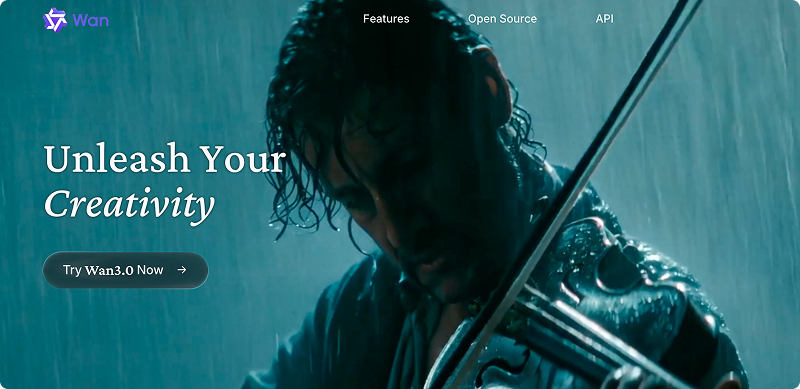
Step 1: Go to Wan 3.0 creation page and select Wan 3.0 from the available video-generation models.
Step 2: Wan 3.0 supports text prompts, reference images and videos, audio, documents, and webpages, with its omni-reference capability letting you combine multiple input types in a single generation.
Step 3: Describe the subject, action, environment, camera movement, and audio you want.
Step 4: Choose the available resolution, aspect ratio, and video duration. Wan 3.0 supports up to 30 seconds of video, with 1080P available as a supported output level.
Step 5: Click Generate and review the result. If the motion, character, camera, or audio isn't right, refine the prompt or adjust your references and generate again.
Method 2: Use the Vidverse AI Video Generator
For beginners, an all-in-one AI video platform is often more convenient than working directly with an API. The basic workflow is usually select Wan 3.0 → upload your input → enter a prompt → choose settings → generate.
We recommend the latest Vidverse AI Video Generator, which makes it easy to create 30-second HD videos and export them without watermarks.
Step 1: Open the Vidverse AI Video Generator and choose your preferred creation method, such as Text to Video, Image to Video, or Reference Video.
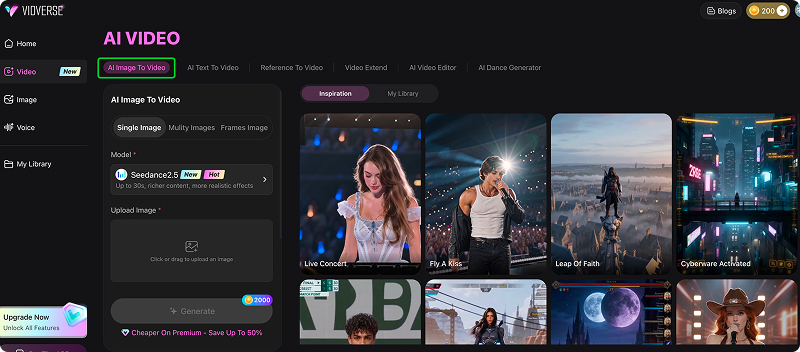
Step 2: Select Wan 3.0, provide a clear prompt or reference, and adjust your video settings.
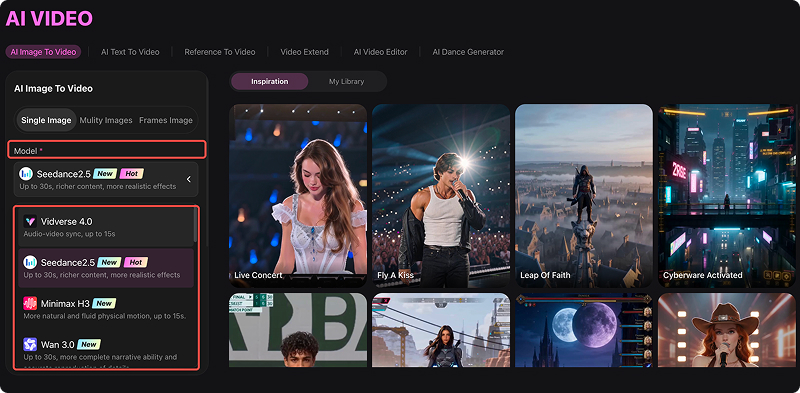
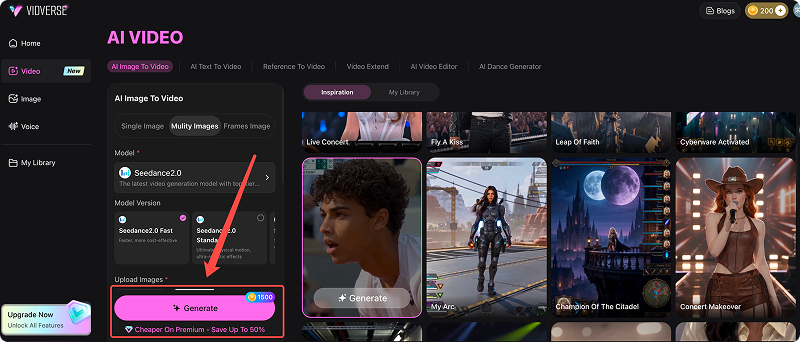
Step 3: Generate the video and compare the result with your original prompt. If necessary, make small changes to the action, camera movement, or reference instructions and try again.
FAQs about WAN 3.0
Is Wan 3.0 free?
Wan 3.0 is not completely free, but eligible new users may receive free credits to try it. After the free quota is used, Wan 3.0 is charged based on video duration and resolution, starting at $0.05 per second for 480P.
Is Wan 3.0 available yet?
Yes. Wan 3.0 is currently available as a public beta through Alibaba Cloud Model Studio and Qwen Cloud. You can experience the model online, while API access is currently offered through an application-based preview and requires approval.
Is Wan 3.0 Better Than Seedance 2.5?
Neither model is universally better. Both support 30-second video generation and advanced multimodal workflows, but they emphasize different strengths. WAN 3.0 focuses heavily on omni-reference creation and native audio-visual generation, while Seedance 2.5 emphasizes long-form storytelling, flexible references, and precise editing.
How much will the Wan 3.0 API cost?
Alibaba Cloud's Model Studio currently lists WAN 3.0 at $0.05–$0.20 per second, depending on resolution.The current listed API rates are:
| Resolution | Price per second | 30-second video |
|---|---|---|
| 480P | $0.05/sec | $1.50 |
| 720P | $0.10/sec | $3.00 |
| 1080P | $0.20/sec | $6.00 |
Which is the best WAN model?
For most users starting a new project, WAN 3.0 is the best overall choice. It is Alibaba's newest WAN video model and supports up to 30-second generation, 1080P output, and multimodal reference inputs such as images, text, video, audio, documents, and webpages.
Final Verdict
If you're only making short, straightforward videos, WAN 2.7 remains a practical choice. But if you want to build more complex, longer, and more production-oriented AI videos, WAN 3.0 is the better long-term option.

'%3e%3crect%20y='2.1906'%20width='26'%20height='17.4314'%20rx='1.55981'%20fill='white'/%3e%3c/g%3e%3crect%20x='0.311961'%20y='2.50256'%20width='25.3761'%20height='16.8075'%20rx='1.24784'%20stroke='%2322257C'%20stroke-width='0.623922'/%3e%3c/g%3e%3crect%20x='13.078'%20y='15.5656'%20width='10.8016'%20height='2.49569'%20rx='0.623922'%20fill='%2366B3FF'%20stroke='%2322257C'%20stroke-width='0.623922'/%3e%3crect%20x='-0.311961'%20y='0.311961'%20width='10.8016'%20height='2.49569'%20rx='0.623922'%20transform='matrix(-1%200%200%201%2012.61%2015.2536)'%20fill='%2366B3FF'%20stroke='%2322257C'%20stroke-width='0.623922'/%3e%3crect%20x='10.3093'%20y='13.3231'%20width='4.91339'%20height='6.98013'%20rx='2.45669'%20fill='%2322257C'/%3e%3cpath%20d='M18.9174%200.31543C20.5962%200.268025%2022.1261%200.655527%2023.9487%201.55762C24.0483%201.60695%2024.1137%201.71153%2024.1137%201.8291V16.502C24.1137%2016.7236%2023.8763%2016.891%2023.6499%2016.7979C21.803%2016.0377%2020.2158%2015.6963%2018.4975%2015.7705C16.8915%2015.8399%2015.1907%2016.2732%2013.0776%2017.0332V1.6709C15.4678%200.825877%2017.2746%200.36187%2018.9174%200.31543Z'%20fill='white'%20stroke='%2322257C'%20stroke-width='0.623922'/%3e%3cpath%20d='M15.3008%204.57C16.3536%203.94578%2019.2783%203.20503%2021.8909%203.94608'%20stroke='%2366B3FF'%20stroke-width='0.935883'%20stroke-linecap='round'/%3e%3cpath%20d='M15.3008%207.26054C16.3536%206.63631%2019.2783%205.89557%2021.8909%206.63661'%20stroke='%2366B3FF'%20stroke-width='0.935883'%20stroke-linecap='round'/%3e%3cpath%20d='M15.3008%209.95107C16.3536%209.32684%2019.2783%208.5861%2021.8909%209.32714'%20stroke='%2366B3FF'%20stroke-width='0.935883'%20stroke-linecap='round'/%3e%3cpath%20d='M15.3008%2012.6398C16.3536%2012.0156%2019.2783%2011.2749%2021.8909%2012.0159'%20stroke='%2366B3FF'%20stroke-width='0.935883'%20stroke-linecap='round'/%3e%3cpath%20d='M7.08257%200.31543C5.40384%200.268025%203.87393%200.655527%202.05132%201.55762C1.95165%201.60695%201.88628%201.71153%201.88628%201.8291V16.502C1.88628%2016.7236%202.12373%2016.891%202.35014%2016.7979C4.19702%2016.0377%205.78418%2015.6963%207.50249%2015.7705C9.10852%2015.8399%2010.8093%2016.2732%2012.9224%2017.0332V1.6709C10.5322%200.825877%208.72541%200.36187%207.08257%200.31543Z'%20fill='white'%20stroke='%2322257C'%20stroke-width='0.623922'/%3e%3cpath%20d='M10.6992%204.57C9.64638%203.94578%206.72175%203.20503%204.10907%203.94608'%20stroke='%2366B3FF'%20stroke-width='0.935883'%20stroke-linecap='round'/%3e%3cpath%20d='M10.6992%207.26054C9.64638%206.63631%206.72175%205.89557%204.10907%206.63661'%20stroke='%2366B3FF'%20stroke-width='0.935883'%20stroke-linecap='round'/%3e%3cpath%20d='M10.6992%209.95107C9.64638%209.32684%206.72175%208.5861%204.10907%209.32714'%20stroke='%2366B3FF'%20stroke-width='0.935883'%20stroke-linecap='round'/%3e%3cpath%20d='M10.6992%2012.6398C9.64638%2012.0156%206.72175%2011.2749%204.10907%2012.0159'%20stroke='%2366B3FF'%20stroke-width='0.935883'%20stroke-linecap='round'/%3e%3c/g%3e%3cdefs%3e%3cfilter%20x='0'%20y='2.1906'%20width='26'%20height='17.4314'%20filterUnits='userSpaceOnUse'%20color-interpolation-filters='sRGB'%3e%3cfeFlood%20flood-opacity='0'%20result='BackgroundImageFix'/%3e%3cfeBlend%20mode='normal'%20in='SourceGraphic'%20in2='BackgroundImageFix'%20result='shape'/%3e%3cfeColorMatrix%20in='SourceAlpha'%20type='matrix'%20values='0%200%200%200%200%200%200%200%200%200%200%200%200%200%200%200%200%200%20127%200'%20result='hardAlpha'/%3e%3cfeOffset%20dy='-1.24784'/%3e%3cfeComposite%20in2='hardAlpha'%20operator='arithmetic'%20k2='-1'%20k3='1'/%3e%3cfeColorMatrix%20type='matrix'%20values='0%200%200%200%200.572549%200%200%200%200%200.768627%200%200%200%200%200.976471%200%200%200%201%200'/%3e%3cfeBlend%20mode='normal'%20in2='shape'%20result='effect1_innerShadow_0_4'/%3e%3c/filter%3e%3c/defs%3e%3c/svg%3e)